

We live in an age defined by speed.
Meals arrive in minutes. Packages arrive tomorrow. Answers appear instantly. Entertainment never ends. Even relationships can begin and dissolve with a swipe of a screen. Technology has given us extraordinary convenience, but it has also formed us in quiet ways. We are becoming people who expect immediacy not only in commerce or communication, but in nearly every part of life.
And when immediacy becomes normal, patience begins to feel unnecessary—almost like a flaw instead of a virtue.
For most of human history, waiting was not an inconvenience. It was simply reality. Food had to be grown before it could be eaten. Clothing had to be made before it could be worn. Skills required years of apprenticeship. Letters traveled slowly. Craft demanded time. Nothing meaningful arrived overnight, and because of that, people understood that process was inseparable from value.
Today, delay feels unnatural. We increasingly measure quality by how quickly something appears rather than how well it was formed. The shift is subtle, but profound. We are not only living faster; we are beginning to expect results without formation.
This is not merely a technological change. It touches something much older in the human heart.
Within the Christian understanding of the fall, there is a recurring pattern: the desire to grasp good things immediately rather than receive them in the time and manner intended. Adam and Eve reach for the fruit before the appointed moment. Israel demands a king rather than waiting in trust. Again and again, the temptation is not toward evil disguised as evil, but toward good things taken too quickly, apart from patience and obedience.
At its core, sin often looks like this quiet impulse—the desire to possess without waiting, to control rather than trust, to arrive without being formed along the way.
Technology did not create this impulse, but it has amplified it beyond anything previous generations could imagine. We can purchase without saving, speak without reflecting, replace rather than repair, and move on rather than remain. Systems designed to remove friction from life have also removed many of the conditions that once produced gratitude, discipline, and
reverence.
Clothing offers one of the clearest mirrors of this transformation. Garments were once the product of measured cuts, skilled hands, careful stitching, and repeated fittings. They required conversation, adjustment, and time. Today, most clothing is mass-produced, fused rather than constructed, sized for averages, and discarded with little thought. Fast fashion is not merely an industrial model; it reflects a cultural posture—immediate possession without lasting value.
True tailoring stands quietly against this current.
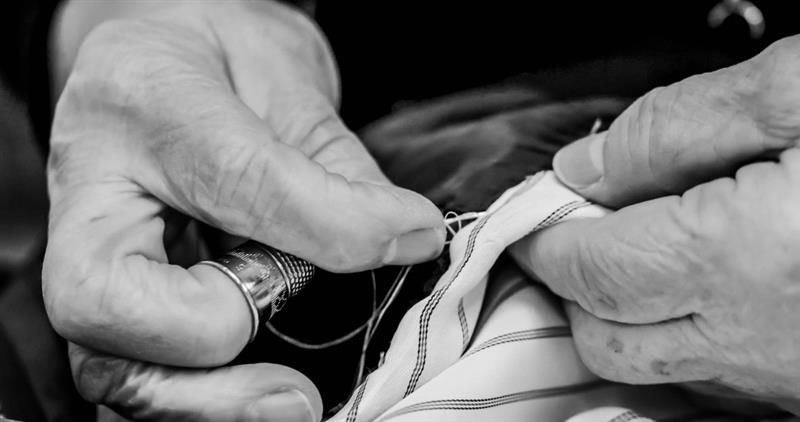
It refuses speed where speed would diminish the result. It insists on measuring before cutting, fitting before finishing, shaping before delivering. Nothing meaningful happens instantly. A well-made garment requires attention, correction, patience, and the steady work of human hands. And in the waiting, something unexpected occurs: the client is formed along with the garment.
There is a dignity to processes that cannot be rushed. Waiting teaches humility, trust, anticipation, and gratitude. When something finally arrives after time and care, we receive it differently. Not merely as a product, but as a gift. This is why heirlooms matter. Why handmade objects feel distinct from manufactured ones. Why craftsmanship carries emotional weight. Time has been woven into them, and we sense it, even if we cannot explain why.
A tailored garment is therefore more than clothing. It is a conversation unfolding over time, a series of refinements, a collaboration between maker and wearer. It cannot be hurried without being diminished. In a culture shaped by instant results, this slowness becomes meaningful. It reminds us that the most valuable things in life are not downloaded or delivered overnight. They are formed slowly, often quietly, and always with care.
When tailoring disappears, the loss extends beyond a single trade. We lose apprenticeship, patience, permanence, and the instinct to repair rather than replace. We lose reverence for material and respect for time. Most of all, we lose the belief that some things are worth doing slowly and well. That loss is cultural before it is commercial.
Choosing tailoring today is therefore a quiet act of resistance. Not resistance to technology itself, but to the idea that speed alone should determine value. At Manno Clothing, the work remains intentionally deliberate. Measurements are careful. Fittings are unhurried. Adjustments are patient. Finishing is thoughtful. Not because faster methods are impossible, but because true formation—of garments and of people—requires time.
The world will continue to accelerate. Convenience will continue to expand. Yet beneath all of it, the human heart still longs for what lasts: for things made slowly, made well, and made with intention. Tailoring remains one of the few places where that longing is still honored.
And perhaps that is why it matters now more than ever