

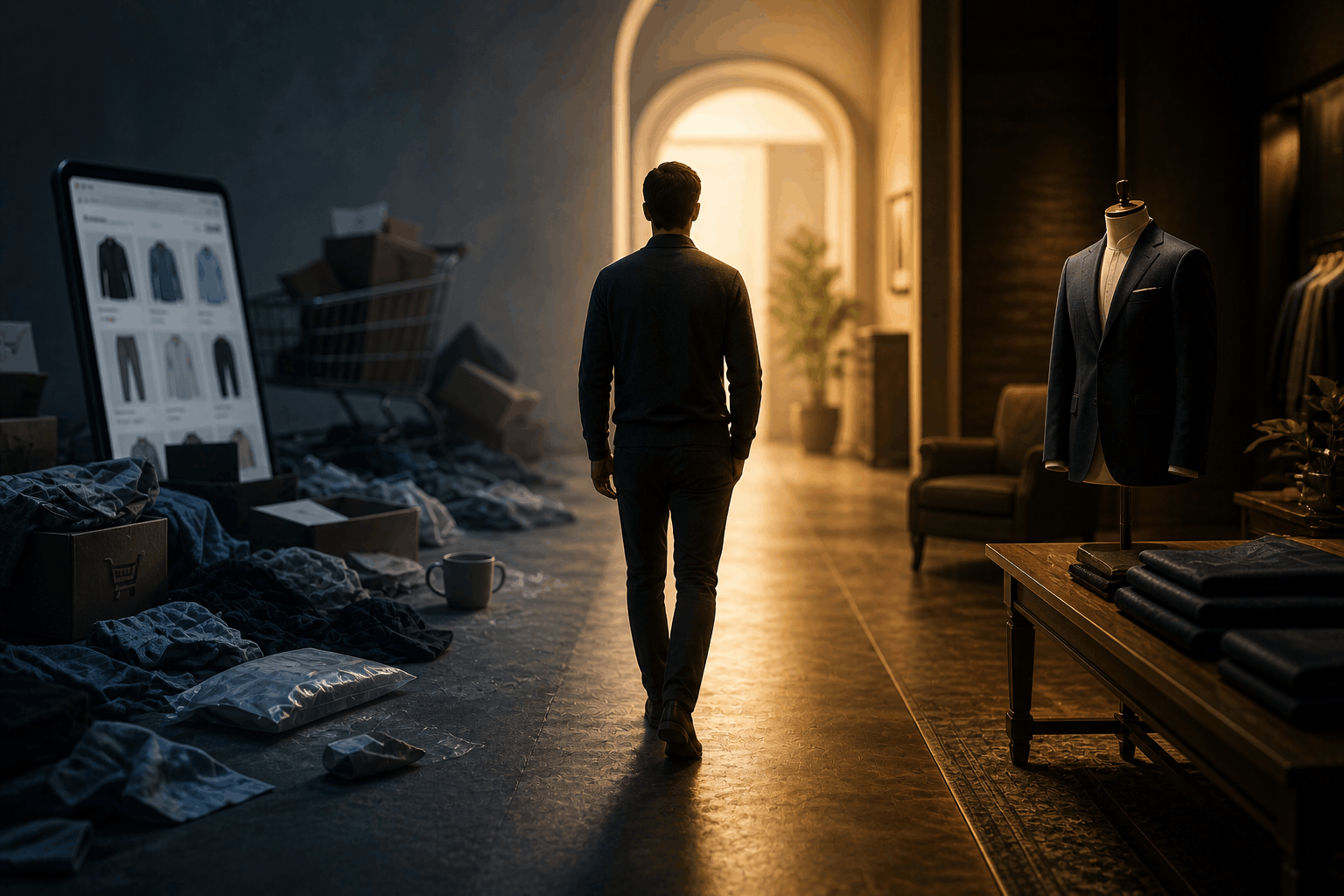
In modern retail, convenience has become the ultimate promise.
One click. Next-day delivery. No human interaction required.
And on paper, what we do at Manno Clothing & Tailoring is unquestionably less convenient.
- We ask you to come into the store.
- We ask you to try things on.
- We ask you to return for alterations and fittings.
- Sometimes we ask you to slow down and think before purchasing.
Compared to ordering five jackets online from your couch at midnight, that sounds inefficient.
But here is the paradox:
What appears less convenient upfront is often dramatically more efficient in the end.
The Illusion of Convenience
Online shopping feels frictionless because there is very little commitment required.
- You scroll.
- You add items to your cart.
- You leave them there.
- You compare twenty more options.
- You revisit the cart three days later.
- Maybe you purchase. Maybe you don’t.
The process feels easy because it asks very little of you.
But was it actually efficient?
How much time was spent searching, comparing, second-guessing, returning, reordering, and waiting?
How many garments arrived looking different than expected? How many fabrics felt cheaper in person? How many “perfect fit” algorithms were wildly inaccurate? How many purchases satunworn in a closet because they never truly felt right?
Modern convenience often pushes the burden of decision-making onto the customer.
- The consumer becomes the stylist.
- The fitter.
- The quality inspector.
- The return department.
The retailer simply ships boxes.
The Cost of Infinite Choice
There is another hidden inefficiency in modern shopping: decision fatigue.
When consumers are presented with endless options, they often become less confident — not
more.
More choices do not necessarily create better outcomes. They often create hesitation.
At our store, we intentionally do the opposite.
We narrow the field.
Instead of asking a client to sort through hundreds of garments online, we curate a handful of pieces specifically for them — based on fit, lifestyle, goals, budget, profession, and personal style.
This is not accidental. It is our philosophy.
A great clothier should not overwhelm a client with options. A great clothier should know enough to guide them toward the right options.
That guidance takes time. It takes conversation. It takes in-person experience.
And yes — it requires the customer to physically show up.
Why Fittings Matter
One of the greatest misconceptions in clothing today is that “close enough” is acceptable.
In reality, fit changes everything.
A garment can be made from extraordinary fabric and still look mediocre if the fit is wrong.Conversely, a properly tailored garment can elevate even simple clothing dramatically.
This is why we insist on fittings and alterations.
Not because we want to create extra steps. Not because we enjoy making clients come back.
But because clothing is three-dimensional and human beings are not standardized.
- Sleeves vary.
- Posture varies.
- Shoulders slope differently.
- Waistlines shift.
- Athletic builds fit differently than slim builds.
- Comfort preferences vary from person to person.
There is no algorithm capable of replacing that level of observation and adjustment.
A return trip for tailoring may seem inconvenient in the short term, but it prevents years of dissatisfaction with clothing that never fit properly to begin with.
The Commitment Effect
There is also something psychologically important about physically entering a store.
When someone makes an appointment, drives to a fitting, tries on garments, and works through a process intentionally, they become more invested in the outcome.
The purchase becomes thoughtful rather than impulsive.
Online shopping often encourages reactionary consumption:
- quick dopamine,
- fast checkout,
- instant gratification.
But intentional purchasing tends to produce longer-lasting satisfaction.
- Clients buy fewer things — but better things.
- They wear them more often.
- They feel more confident in them.
- They waste less money overall.
Ironically, what feels slower can actually create faster clarity.
Hospitality Over Transaction
At Manno Clothing & Tailoring, we do not view clothing as a commodity alone.
We view it as personal.
The experience matters:
- the conversation,
- the guidance,
- the tailoring,
- the education,
- the hospitality,
- the confidence a client feels when they leave.
That simply cannot be replicated by a cardboard box on a porch.
The modern retail world has optimized for speed. We have chosen to optimize for outcome.Those are not always the same thing.
Slowing Down to Save Time
The irony is that many of the clients who initially think our process sounds “less convenient” eventually realize
it simplifies their lives.
They stop endlessly searching online.
They stop buying duplicates.
They stop dealing with constant returns.
They stop wondering whether something fits correctly.
Instead, they develop a trusted relationship.
They walk into a store where someone already understands:
- their sizing,
- their preferences,
- their profession,
- their lifestyle,
- and how they want to present themselves to the world.
That relationship removes friction in a much deeper way than one-click checkout ever could.
The Real Question
Convenience should not simply be measured by how fast something arrives.
It should be measured by:
- how well it works,
- how long it lasts,
- how confident it makes you feel,
- and how much unnecessary friction it removes over time.
Because sometimes the most efficient path is not the fastest one.
Sometimes the better experience requires slowing down long enough to do things properly