

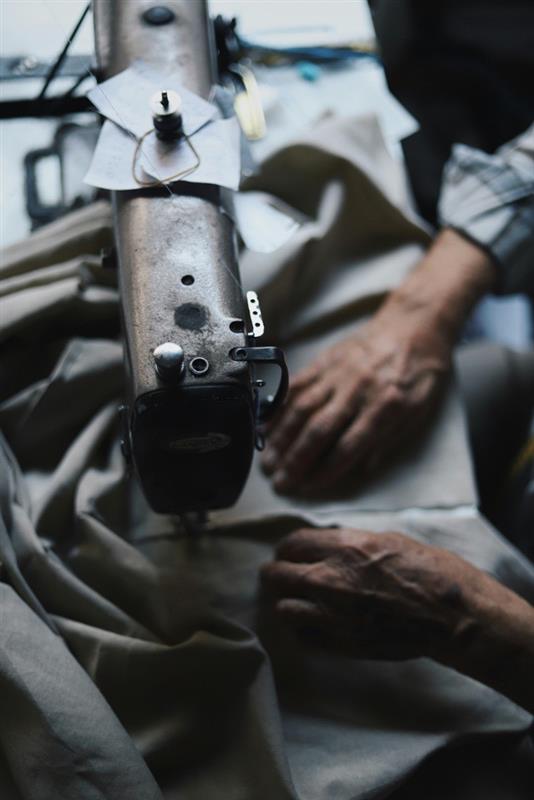
Our shop didn’t start with a brand strategy or a marketing plan. It started with work.
Like many small businesses built by immigrant families, tailoring began as a practical skill learned out of necessity. That’s the story of my grandparents, Leonardo and Lilla Manno. Sicily didn’t teach them fast fashion. Sicily taught them how to make something last. You learned how to repair instead of replace. You learned that your hands were your livelihood, and that doing the job well—quietly, consistently—was how trust was earned.
Tailoring was never glamorous. It still isn’t. But what it is, is worth it. Most beautiful things are this way. Precise. Patient. Demanding. It meant standing over a workbench long after the store lights went out, studying fabric, posture, balance, and movement. The reward wasn’t attention. The reward was knowing that when someone put on a jacket, it simply felt right—because someone had cared enough to make it so.
That kind of work still matters. Even if the world has moved on.
Today, most clothing is designed to be fast, cheap, and temporary. Garments are fused instead of built, sized for averages that fit no one particularly well, and replaced the moment something shifts or wears out. Convenience has replaced craftsmanship. Speed has replaced skill. Stretch has replaced balance.
And with that shift, something more than quality has been lost.
Tailoring is not just “hemming pants.” It is a trade passed down through apprenticeship, repetition, and judgment. A tailor learns how a shoulder rolls forward, how a collar should sit against the neck, how a sleeve must move when a person reaches, sits, or walks. These are not things you can automate or artificially replicate. They are learned through time, care, and disciplined practice.
When trades disappear, we don’t just lose services—we lose standards. We lose the expectation that things should be done well, even when no one is watching.
For decades, large and powerful segments of the clothing industry had an opportunity to protect this trade. They had the reach, the resources, and the customer base to elevate tailoring into a respected profession—one that could have rivaled electricians, pipefitters, and plumbers in both skill and stability. Instead, many chose the easier route. Cost-cutting replaced training. Speed replaced mentorship. Services that once supported proper fit and long-term wear were quietly removed in favor of volume and margins.
The result wasn’t progress—it was abandonment. And when responsibility is removed at scale, the cost is eventually paid by culture.
Small businesses—especially those built by immigrant families—have long been the quiet defenders of what was left behind. They preserve skills not because it’s trendy, but because it’s right. They teach younger generations that work has dignity, that details matter, and that shortcuts eventually cost more than they save.
That same philosophy is at the heart of traditional tailoring.
A well-made garment is not about status. It’s about stewardship. A jacket that can be adjusted, repaired, relined, and worn for decades respects the material it’s made from and the person wearing it. It honors the idea that some things are worth maintaining.
This is where the conversation about dressing well (not “dressing up”) often gets misunderstood.
Dressing well is not about vanity. It is not about chasing trends or impressing others. At its core, dressing well is about responsibility—how we choose to show up in the world.
What we wear communicates whether we take ourselves seriously, whether we respect the moment we’re in, and whether we’ve considered the people around us. Like it or not, appearance speaks before words do. It always has.
A properly fitting jacket changes how a person stands. A well-cut shirt affects how they carry themselves. Clothing that fits and functions properly encourages confidence, composure, and presence. These aren’t abstract ideas—they’re physical realities.
This is why tailoring matters culturally. It reminds us that effort is visible. That care shows. That how you present yourself is often a reflection of how you approach your work, your family, and your responsibilities.
At Manno Clothing, we see ourselves not as trend-chasers, but as defenders of this way of thinking. We believe fit matters. Craft matters. Standards matter. Not because they make someone better than anyone else, but because they ask more of us. This mindset shapes everything we do—from the fabrics we source to the way we welcome people into our shop. It may seem unreasonable today—and that’s precisely why it matters.
We stand by the conviction that how you dress shapes how you move through the world. That clothing built with intention encourages people to live with intention. And that preserving traditional tailoring is ultimately about preserving dignity—in work, in appearance, and in daily life.
This isn’t nostalgia. It’s continuity.
Every generation decides what is worth keeping. Tailoring is one of the world’s oldest professions. It has survived wars, economic shifts, and cultural change because it serves something fundamental: the human desire to do things well and to be seen as capable and put together.
In a disposable age, choosing quality is a quiet act of resistance. Choosing repair over replacement is a statement of care. Choosing to dress well—thoughtfully, respectfully—is a way of saying that the moment, and the people in it, matter.
Tailoring is not about the past. It’s about carrying forward the idea that some things are worth doing properly, even when it takes longer.
And that is a conviction worth preserving.