

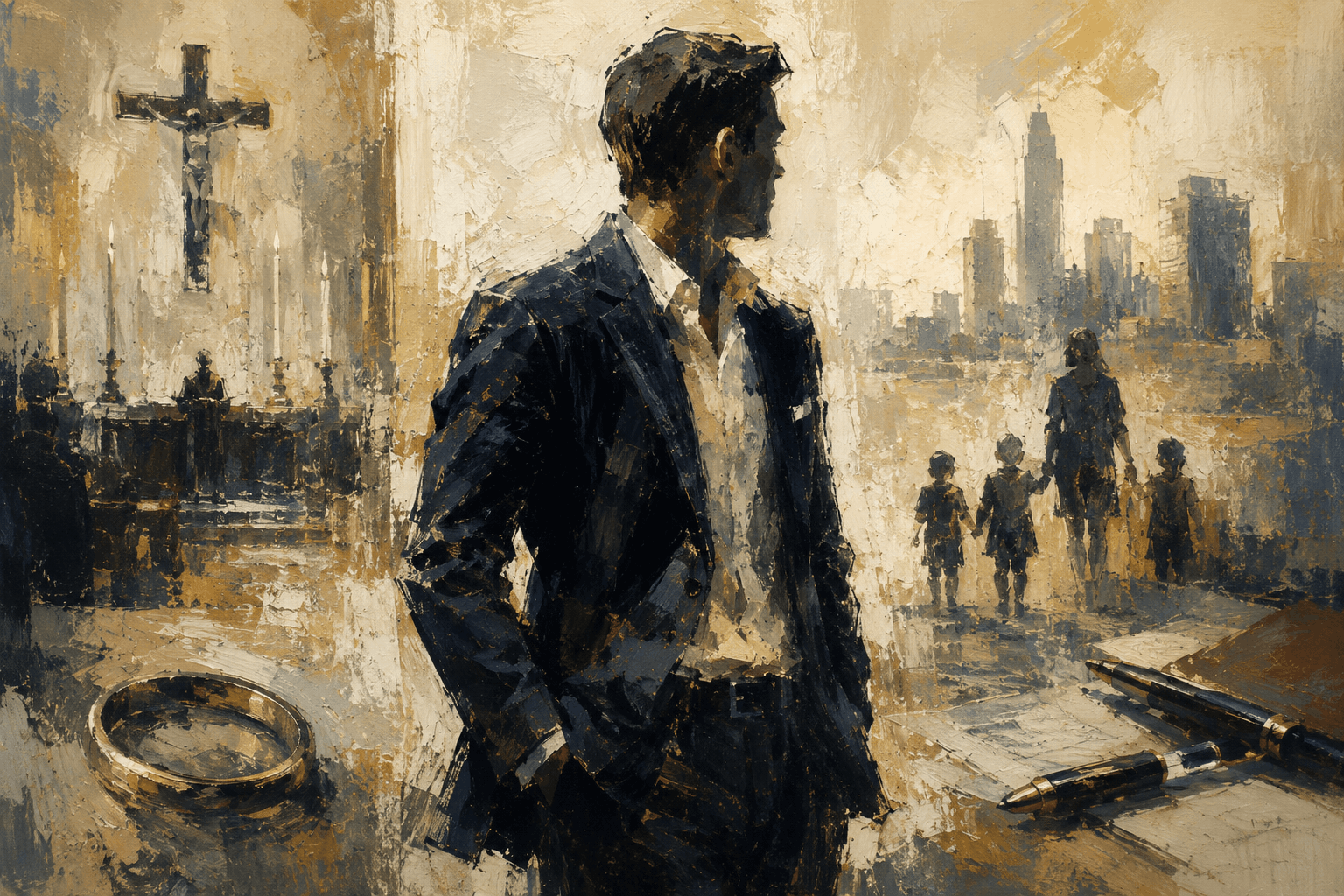
There is a tendency in modern “Church culture” to dismiss appearances as superficial.
- “Clothing doesn’t matter.”
- “It’s what’s on the inside that counts.”
- “God doesn’t care what you wear.”
- In one sense, all of these statements contain some truth.
- A suit cannot make a man virtuous.
- A sport coat cannot make a man responsible.
- A tie cannot make a man faithful.
History is full of well-dressed men who lacked integrity and poorly dressed men who possessed tremendous character.
Yet as Catholics, we know there is more to the story.
Because Catholicism has always understood something profound about human nature: what we do on the outside often shapes what happens on the inside.
- We are not merely souls.
- We are body and soul together.
- And because of that, the visible and invisible are constantly interacting.
- The Catholic faith is built upon this reality.
- God uses physical things to communicate spiritual truths.
- Water in Baptism.
- Bread and wine in the Eucharist.
- Oil in Confirmation.
- A wedding ring in Matrimony.
- A priest’s collar.
- A crucifix hanging in a home.
None of these things are important merely because of what they are made of. They are important because they point toward something greater than themselves.
They are visible signs of invisible realities.
Perhaps that principle extends further into our lives than we often realize.
What Makes a Man Good?
Before discussing clothing, it is worth asking a more important question:
What makes a man good?
The world offers countless answers.
- Strength.
- Success.
- Influence.
- Status.
- Wealth.
- Achievement.
- Yet none of these things, by themselves, make a man good.
- The Catholic tradition offers a different answer.
- A good man is one who willingly accepts responsibility for what God has entrusted to him and
lovingly sacrifices himself for the good of others. - A good husband places his wife before himself.
- A good father puts the needs of his children ahead of his own comfort.
- A good employer recognizes that families depend upon the decisions he makes.
- A good friend remains loyal even when it is inconvenient.
- A good Christian understands that true greatness is found not in being served, but in serving.
This is the model Christ gives us.
The Son of God did not come to be served, but to serve.
He carried a cross before He wore a crown.
That is manhood.
Every other expression of authentic masculinity ultimately flows from that example.
The Decline in Dress Is Not a Clothing Problem
Many people lament the decline of dress in our culture.
They point to sweatpants in public, athletic wear in professional settings, and the increasingly casual nature of nearly every environment.
But clothing is rarely the root issue.
The decline in dress is not primarily a clothing problem.
It is a vocation problem.
When men lose sight of who they are called to be, the outward signs of maturity often disappear as well.
For generations, clothing served as a visible acknowledgment that a man had accepted certain responsibilities.
He was no longer simply living for himself.He was a husband. A father.A provider.A leader within his family and community.
Today many of those distinctions have become less clear.
The result is not merely a change in fashion.
It reflects a deeper uncertainty about what it means to become a man.
Visible Signs of Invisible Commitments
- Catholics understand the importance of visible signs.
- A wedding ring does not create a marriage, but it communicates a covenant.
- A priest’s collar does not make him holy, but it communicates a vocation.
- A crucifix does not save a home, but it reminds us of the One who can.
- These visible signs point toward invisible commitments.
- Clothing can function in a similar, though far lesser, way.
- The jacket does not make the man.
- The suit does not confer responsibility.
- The tie does not create virtue.
- But each can serve as a reminder.
- A reminder that others depend upon us.
- A reminder that our actions carry weight.
- A reminder that we have accepted responsibilities larger than ourselves.
- A reminder that our vocation matters.
- A suit does not make a man responsible.
But responsible men often choose to dress differently because they understand the weight of
their vocation.
Taking Things Seriously
Perhaps the real question is not whether clothing matters.
The real question is whether anything matters.
If marriage is sacred, should it not affect how a husband carries himself?
If fatherhood is sacred, should it not influence how a father presents himself to his children?
If work is a vocation and not merely a paycheck, should it not shape the way we approach our
responsibilities?
If the Mass is the highest form of worship, should it not change the way we prepare for it?
Catholics have always answered these questions in the same way: our outward actions should
reflect our inward convictions.
Not because appearances are everything.
But because what we believe should eventually become visible.
The man who dresses intentionally is not necessarily making a statement about fashion.
He may simply be making a statement about significance.
- That his marriage matters.
- That his family matters.
- That his work matters.
- That his faith matters.
That the life God has entrusted to him is worthy of care, attention, and respect.
Reverence Beyond Sunday
Too often, reverence is viewed as something reserved for church.
Yet reverence is not merely a posture for Mass.
It is a way of approaching life.
The same man who kneels before God on Sunday should strive to honor his wife on Monday.
The same man who reverently enters a church should reverently approach the responsibilities
entrusted to him at work.
The same man who believes Christ is present in the Eucharist should recognize that God is
present in the ordinary duties of his vocation.
A Catholic man is called to live with intentionality.
- To reject perpetual adolescence.
- To embrace responsibility.
- To understand that the ordinary moments of life are worthy of dignity and care.
- This does not require expensive clothing.
- It does not require a suit every day.
- It does not require perfection.
- It simply requires recognizing that what we do matters.
And when something matters, we tend to act differently.
The Visible Signs of Our Lives
At Manno Clothing, we spend our days discussing garments, fabrics, fit, and craftsmanship.
Yet clothing has never been the ultimate goal.
The goal is not to wear a jacket because gentlemen wear jackets.
The goal is to wear a jacket because you have accepted responsibilities that require you to think
and act like a gentleman.
The goal is not to dress well for the sake of appearance.
The goal is to become the type of man whose outward actions reflect his inward convictions.
Because ultimately, the visible signs of our lives should point toward the invisible commitments of our hearts.
- Not only at Mass.
- Not only on special occasions.
- But in every aspect of the life God has entrusted to us.
And perhaps that is what manhood truly is:
- Accepting responsibility.
- Serving others sacrificially.
- Living with reverence.
And allowing the visible signs of our lives to bear witness to the invisible truths we profess to
believe